
Credit Education
Understanding credit is essential to improving it. With the right knowledge, you can make informed decisions and take control of your financial future.
At Bright Solution Credit Repair, we provide clear, structured credit education to help you understand how credit works, what impacts your score, and the steps needed to improve and maintain it.
Our goal is not just to guide you through the process, but to give you the knowledge and confidence to manage your credit long-term.
Start building a stronger financial foundation today.
What is a Credit Score?
A credit score is a number calculated using a mathematical formula that helps predict your creditworthiness. Scores typically range from 300 to 850. The higher your score, the more likely you are to be approved for credit and receive favorable terms. The lower your score, the more difficult it may be to qualify. Even when approved with a lower score, lenders often charge higher interest rates. Over time, this can cost you thousands of dollars more on mortgages, auto loans, and credit cards. Maintaining a strong credit score not only improves your chances of approval—it also helps you save money and access better financial opportunities.
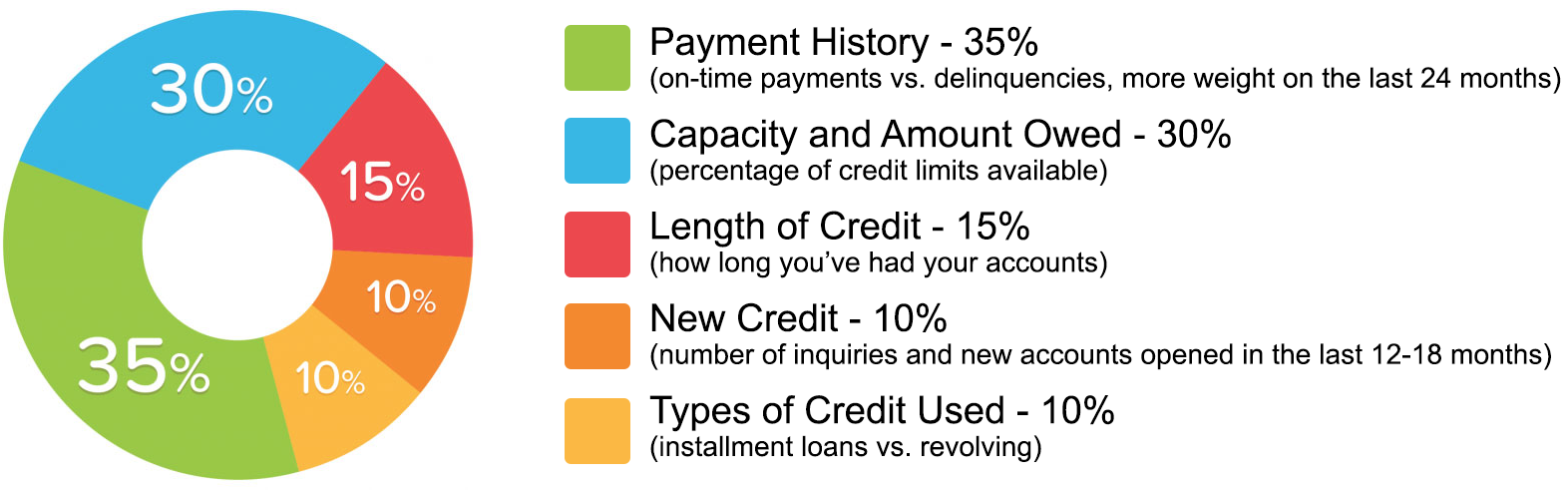
What affects your Credit Score?
How We Help Improve Your Credit
We assist you in identifying and disputing inaccurate, outdated, or unverifiable negative items affecting your payment history.
We also guide you on how to improve your credit utilization and overall profile—even in situations where paying off balances immediately may not be an option.
In addition, we can help address certain credit inquiries that may be impacting your report.
Many consumers are aware of the three major credit bureaus—Equifax, Experian, and TransUnion—but may not realize that each report can differ significantly. In many cases, there can be substantial variations between scores due to inconsistencies, incomplete reporting, or errors.
Studies have shown that a large percentage of credit reports contain inaccuracies, ranging from minor discrepancies to more serious reporting issues. Identifying and addressing these issues is a key part of improving your credit profile.
How You Can Improve Your Credit
Improving your credit requires consistent habits and responsible use of credit over time. Key steps include:
- pay all bills on time, including utilities, loans, and credit cards
- review your credit report regularly to monitor accuracy
- keep credit card balances below 30% of the available limit
- continue using credit responsibly instead of avoiding it completely
- keep older accounts open to maintain a strong credit history
If you are concerned about overspending, consider using your credit card only for small recurring expenses, such as utilities, and paying the balance in full each month.
Building Long-Term Credit Strength
Maintaining good credit is a long-term process. Consistency is key.
Even if you do not see immediate results, continuing these habits over time will help improve your score and position you for better interest rates and financial opportunities.
How Long Items Stay on Your Credit Report
Different types of information remain on your credit report for specific periods:
- Late Payments (30–180 days): up to 7 years from the original missed payment
- Collection Accounts: up to 7 years from the original delinquency date
- Charge-Off Accounts: up to 7 years from the original delinquency date
- Closed Accounts: positive accounts may remain up to 10 years; negative history up to 7 years
- Lost Credit Cards: up to 2 years if no delinquencies; negative history up to 7 years
- Bankruptcies: Chapter 7, 11, 12 up to 10 years; Chapter 13 up to 7 years
- Judgments: up to 7 years from filing
- Tax Liens: unpaid up to 15 years; paid up to 10 years
- Inquiries: typically up to 2 years
Information That Cannot Be Reported
Certain information cannot legally appear on your credit report, including:
- medical information without your consent
- bankruptcies older than the allowed reporting period
- debts older than 7 years (in most cases)
- personal details such as race, marital status, or age in employment-related reports
Real Clients. Real Results.

If I'd known how easy this was going to be, I'd have done it years ago.

Very easy and worth every penny.
.
I will recommend this service to everyone I know. Just amazing.


